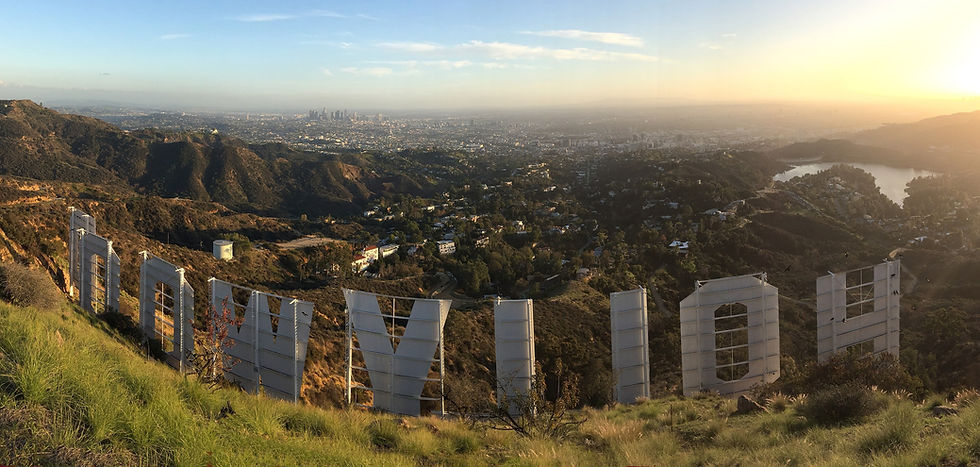
THE SOUND OF U.S. SILENCE

How the 2026 Emmys Revealed a Muted and Cautious Version of Hollywood
Having just returned from the floor at the Peacock Theater for the 78th Primetime Emmy Awards, one reality settled over the room: Hollywood hasn't just become cautious, it has become quiet. The arc of the 2026 awards season shows a U.S. entertainment establishment retreating into self-censorship, while Europeans and Canadians are speaking up. As historical precedent shows, authoritarian pressure succeeds not just through force, but when culture voluntarily retreats into silence out of fear.
January 2026, The Golden Globes
Back in January, Hollywood's strategy for managing broadcast risk became immediately clear: keep political outrage off the main stage and quarantine it to pre-show interviews. Outside on the red carpet, stars like Mark Ruffalo, Wanda Sykes, and Jean Smart wore pins honoring ICE shooting victim Renée Good and "ICE OUT" pins, speaking openly to journalists about civil liberties and government overreach. Yet once the broadcast went live, political acceptance speeches were 100% absent from the podium. Aside from a few oblique jokes, winners kept their speeches strictly focused on safe gratitude. (Deadline)
March 2026, The Oscars
By March, a few brave creators managed to break through the broadcast firewall on the Dolby Theatre stage. While presenting Best International Feature, Javier Bardem wore a "No a la Guerra" badge and declared directly into the camera: "No to war, and free Palestine", drawing immediate, echoing applause from the room. (Screendaily)
Moments later, the documentary winners for Mr. Nobody Against Putin delivered a stinging warning about silence and complicity: "When we act complicit, when a government murders people on the streets of our major cities, when we don't say anything... we all face a moral choice." It was a brief, powerful flash of artistic resistance on U.S. television. And, as it turned out, the last one we would see all year. (The New York Times)
The Emmys, 2025 and 2026
By the time the 78th Emmy Awards arrived on September 14th, self-censorship had achieved complete and total lockdown, creating a jarring contrast with previous cycles. Just last year, the room erupted in applause when hosts like Jimmy Kimmel openly mocked political intimidation after Donald Trump publicly targeted late-night shows and boasted that Kimmel was next on the chopping block. Back then, artists leaned into the fight: Meg Stalter carried a "CEASEFIRE!" purse on the red carpet, and Javier Bardem wore a keffiyeh while declaring he wouldn't work with studios that back conflict. (NBC)
Flash forward to this September, in the wake of Colbert’s forced late-night departure and widespread corporate self-censorship, and the erasure was absolute. Gone were the red carpet pins, the anti-war statements, and the stage riffs against political overreach. Facing sponsor anxieties, executive panic, and fear of federal retaliation, domestic TV leaders scrubbed the telecast entirely. Winner after winner delivered polite, sanitized, play-it-safe thank-yous.
When the arts fall silent under pressure, is it self-restraint—or self-surrender?
September 2026, Venice and TIFF
In stark contrast to Hollywood's stage silence, international festival podiums actively embraced live political friction. At Venice, George Clooney used his stage time to directly attack government intimidation, warning that "authoritarians always try to shut down the artists first", while Jury President Maggie Gyllenhaal pushed back against industry caution by declaring that cinema is "unavoidably political." (Deadline)
During the opening night ceremony at TIFF Lightbox, TIFF CEO Cameron Bailey and Toronto Mayor Olivia Chow took the stage to directly address the escalating U.S.–Canada trade tensions, new tariffs, and political overreach. Mayor Chow explicitly praised artists and activists for standing up against "the might of the U.S. government," while Bailey used his opening address to make a pointed statement on Canadian sovereignty and cultural independence. Furthermore, the Palestinian displacement documentary Thirteen in Gaza took home a major festival award. (The New York Times)
Lip it or Zip it?
When art surrenders to fear, everybody loses. As decision-makers, we have to actively resist this creep of self-censorship. Looking ahead to 2027, our hope is that Hollywood reclaims its spine and brings back an awards season defined by fearless voices, political fire, and uncompromising creative truth. We need this now more than ever—because as George Orwell wrote in 1945, in a preface suppressed by publishers for nearly thirty years out of political fear: "If liberty means anything at all, it means the right to tell people what they do not want to hear."
Cheers,
Laura